PART 5: THE CHRISTMAS GIFT THEY COULD NEVER TAKE AWAY
“Where did you get those records?” my mother demanded again, her voice trembling as she stared at the folder in Rachel’s hands.
Nobody answered her immediately.
My father sat motionless.
Bella looked confused.
And Margaret, who had remained remarkably composed throughout the proceedings, finally spoke.
“Your mother kept copies of important financial documents with me before she passed away. She trusted me to protect them.”
Mom shook her head.
“That’s impossible.”
Margaret looked directly at her.
“Apparently, you underestimated her.”
Rachel placed the newly discovered records on the table and began discussing them with the other attorneys.
I watched my mother’s expression change with every passing minute.
The confidence was gone.
The anger was disappearing.
All that remained was desperation.
During the next recess, Rachel took me into a private conference room.
She closed the door and spread several documents across the table.
“Jessica, remember when your father told you that very little of your inheritance remained?”
I nodded.
“He wasn’t being completely truthful.”
My stomach tightened.
“What do you mean?”
“The newly located records identify an investment account connected to funds distributed from your grandmother’s estate. Your mother transferred a substantial amount into it shortly after receiving your inheritance.”
“How substantial?”
Rachel pointed toward a figure.
“Based on the available records, approximately $162,000 may still be traceable to that account and related investments. We need current statements and independent verification, but this is a significant development.”
I stared at the number.
One hundred and sixty-two thousand dollars.
For weeks, I had believed nearly everything Grandma left me had disappeared.
“Why would Mom tell us the money was gone?”
Rachel leaned back in her chair.
“That’s a question your mother will need to answer.”
But I already suspected the answer.
My parents had been keeping whatever money remained as their own financial safety net.
They had allowed their mortgage payments to fall behind.
They had continued demanding that I finance Bella’s education.
They had attempted to obtain another $35,000 using my information.
All while potentially protecting a substantial amount of money that had belonged to me from the beginning.
I covered my face with my hands.
“They could have paid their own bills.”
Rachel remained silent.
“They could have helped Bella. They could have saved their house. They could have stopped asking me for money.”
My voice began breaking.
“But they wanted to keep mine.”
That realization hurt more than I expected.
Their financial problems hadn’t always been unavoidable emergencies.
Some of those emergencies had become my responsibility because they wanted to preserve their own comfort.
I remembered calling my mother one evening when Grace had a fever and I was worried about missing work.
Mom had asked whether I could still transfer Bella’s tuition payment before midnight.
She hadn’t asked how Grace was feeling until the money arrived.
I remembered postponing dental treatment because Dad needed help with an unexpected expense.
I remembered wearing the same winter coat for six years.
I remembered Grace standing in a toy store, looking at a little dollhouse before quietly putting it back because she knew Mommy was trying to save money.
All those sacrifices.
All those unnecessary moments of worry.
And somewhere, money that should have protected us had been sitting beyond our reach.
“Rachel,” I whispered, “I don’t want Grace to grow up thinking this is normal.”
“She doesn’t have to.”
I took a deep breath.
“Then let’s finish this.”
When we returned to the courtroom, my mother’s attorney requested additional time to review the newly discovered information.
Further financial disclosures were required, and the court issued orders intended to preserve the disputed assets while the matter continued.
My mother looked as though the floor had disappeared beneath her feet.
As we left the courtroom that afternoon, she hurried toward my father.
“You promised me nobody would find those records!”
Several people turned toward her.
Dad looked exhausted.
“Stop, Helen.”
“Everything is falling apart because of you!”
“No,” he replied quietly. “It’s falling apart because of what we did.”
She slapped the papers against his chest.
“You’re supposed to stand beside your wife!”
“I stood beside you for years.”
His voice cracked.
“And look what it cost our daughter.”
Mom turned toward me.
“You’re enjoying this, aren’t you?”
I looked at her for a long moment.
“No, Mom. I’m grieving.”
She frowned.
“Grieving what?”
“The family I thought I had.”
For once, she had nothing to say.
I walked away with Rachel.
Outside the courthouse, the winter air felt unusually refreshing.
Aunt Linda was waiting near the steps.
She hugged me without asking any questions.
Margaret joined us a moment later.
“Your grandmother would be proud of you,” she whispered.
I began crying.
Not because I had won.
Nothing had been completely resolved yet.
But because someone had finally said the words I had spent my entire life hoping to hear from my mother.
That evening, I returned to my apartment carrying a bag of Grace’s favorite takeout food.
She opened the door wearing her pajamas and a ridiculous pair of fuzzy slippers.
“Mommy!”
She threw her arms around my waist.
“Did you get our someday house?”
I smiled.
“Not yet, sweetheart.”
“That’s okay. We have this house.”
I knelt beside her.
“Yes, we do.”
She took my hand and led me toward the dining table.
There were two pieces of paper waiting for me.
One was a picture of our apartment.
The other was a picture of the house on Willow Creek Road.
Underneath both, she had written the same words.
“HOME IS WHERE MOMMY IS.”
I stared at those words until they blurred.
For months, I had been fighting to recover a house because I wanted to give Grace a home.
And somehow, my seven-year-old daughter had already understood something I was still learning.
A home wasn’t simply a building.
It was the place where you felt safe enough to be yourself.
That night, we ate dinner on the couch and watched an animated movie.
My phone vibrated repeatedly.
I ignored it.
For the first time in years, someone else’s emergency wasn’t going to interrupt my daughter’s happiness.
The following weeks were filled with financial reviews, legal discussions, and difficult decisions.
The newly discovered investment records were verified.
Substantial funds remained available, although some investments had fluctuated in value and other transactions required closer examination.
The proposed private sale of the Willow Creek property had not been completed.
Grace’s educational trust was independently confirmed to be intact.
And the evidence concerning the unauthorized loan application was preserved for the appropriate authorities.
Then Rachel called me one Monday morning.
“Your mother’s attorney has submitted a revised settlement proposal.”
I put down my coffee.
“How different is it?”
“Considerably different.”
She explained that my parents were prepared to cooperate with the recovery of the remaining traceable inheritance funds, liquidate certain assets, provide additional financial disclosures, and enter an enforceable repayment arrangement for an agreed portion of the remaining losses.
Bella was also considering relinquishing her claim to the Willow Creek house.
“What about the rent she collected?” I asked.
“That remains part of the negotiations.”
“And Grandpa’s money?”
“We’re accounting for the historical claims and the available evidence. Some issues are more difficult to pursue because of the time that has passed.”
I nodded.
I knew that recovering every dollar might be impossible.
But I wasn’t willing to accept another vague promise from people who had already broken dozens of them.
“Everything needs to be documented,” I said.
“Absolutely.”
“And I won’t agree to anything that requires me to lie about what happened.”
Rachel smiled.
“I wouldn’t recommend that you do.”
There was one more condition I made clear.
Grace was not to be used as a bargaining tool.
Nobody would demand access to her in exchange for returning money or property.
Nobody would send her messages asking her to persuade me.
Nobody would make her feel responsible for repairing the relationships the adults had damaged.
My daughter’s childhood was not part of the negotiations.
Three days later, Bella asked to meet with me again.
This time, she wasn’t carrying an expensive handbag or wearing designer shoes.
She arrived wearing her grocery store uniform beneath an ordinary jacket.
“I only have forty minutes before my shift,” she explained.
I nodded.
For a moment, we sat quietly across from each other.
Then she removed a folder from her bag.
“My attorney explained everything to me.”
“Okay.”
“He said there are serious problems with the way the house was transferred.”
I waited.
“And even if I tried to fight it, there’s a possibility I’d lose anyway.”
“That’s something you need to discuss with him.”
She nodded.
“I’m going to agree to return the house.”
I looked at her carefully.
“Why?”
She appeared surprised by the question.
“Because it’s yours.”
For years, I had wanted to hear Bella acknowledge that something belonging to me didn’t automatically belong to her.
Now that she finally had, I wasn’t sure how to respond.
She continued.
“I’ve also agreed to provide the rental records and cooperate with the accounting.”
“That’s good.”
“I’m not saying this because I expect you to forgive me.”
I remained silent.
She wiped her eyes.
“I’ve been working for almost two months now. I get up before sunrise. My feet hurt when I come home. Sometimes customers shout at me over things I can’t control. And when I get my paycheck, most of it disappears into bills.”
I knew that feeling all too well.
“I started thinking about how many years you did that,” she whispered.
“How many times you came home tired and still took care of Grace. How many times I called you asking for money without even asking how you were.”
Her voice cracked.
“I was horrible to you.”
I looked out the window.
“You were.”
“And I was horrible to Grace.”
“Yes.”
She began crying.
“I keep remembering Christmas Eve. Brooke asked me whether Grace would be upset. I told her she’d get over it.”
I swallowed hard.
“She was seven years old, Bella.”
“I know.”
“She thought her grandparents didn’t love her anymore.”
Bella covered her face.
“I’m so sorry.”
For the first time, I believed she was beginning to understand.
But understanding the damage didn’t immediately repair it.
“Bella, I hope you become someone you can be proud of. I hope you finish university. I hope you build a wonderful life.”
She looked at me through her tears.
“But you have to build it yourself.”
She nodded.
“I know.”
“And if we ever have a relationship again, it won’t be because I pay your bills.”
“I understand.”
Before leaving, she reached into her pocket and placed a small envelope on the table.
“What’s that?” I asked.
“Two hundred dollars.”
I frowned.
“Bella, the financial arrangements are being handled by our attorneys.”
“I know. That’s not what this is.”
She pushed the envelope slightly closer.
“It’s from my paycheck. I remembered that you canceled Grace’s birthday party once because I needed money. I wanted to give something back.”
I looked at the envelope.
Then I pushed it gently toward her.
“Keep it.”
Her face fell.
“I don’t want you to think I’m refusing responsibility.”
“Then honor the legal agreements. Pay your own bills. Finish your education when you can afford it. Learn to treat people better.”
She stared at me.
“That will mean more than two hundred dollars.”
She slowly took the envelope back.
Before walking away, she whispered, “I wish I could go back to Christmas Eve.”
“So do I.”
She paused.
“What would you change?”
I thought about it.
“Nothing I did after reading that note.”
Her eyes filled with tears again.
Then she left.
A week later, my father met with investigators and continued cooperating with the financial review.
He acknowledged his involvement and provided additional records.
He also began taking responsibility for the arrangements needed to resolve the disputed assets.
One evening, he called me.
“Jessica, I’ve been thinking about something you said.”
“What?”
“You asked why I didn’t protect you.”
I waited.
“I spent years telling myself that keeping the peace was more important than confronting your mother.”
His voice trembled.
“But I wasn’t keeping the peace. I was just making sure you were the one paying for it.”
I closed my eyes.
That was perhaps the most honest thing he had ever said to me.
“Dad, every time you asked me to understand Mom, you were asking me to accept something you knew was wrong.”
“I know.”
“And every time you stayed silent, you taught Bella that hurting me had no consequences.”
He began crying.
“I wish I could change it.”
“You can’t.”
“I know.”
“But you can choose what you do next.”
He took a deep breath.
“Do you think you’ll ever forgive me?”
“I don’t know.”
There was a long silence.
Then he said, “That’s fair.”
For the first time, my father accepted an answer he didn’t want without trying to make me feel guilty.
It was a small beginning.
Not forgiveness.
Not reconciliation.
Just a beginning.
My mother, however, continued resisting reality.
She insisted that the settlement was unfair.
She complained that everyone had abandoned her.
She blamed my father for providing the records.
She blamed Bella for returning the house.
She blamed Margaret for preserving Grandma’s documents.
She blamed Mr. Anderson for reopening questions about the estate.
And, above all, she blamed me for refusing to remain silent.
Then came the final confession.
It happened during a meeting arranged through our attorneys.
My mother had agreed to discuss several remaining discrepancies in the financial records.
She arrived looking tired and defeated.
For nearly an hour, she answered questions reluctantly.
Eventually, one of the attorneys asked why she had continued soliciting financial assistance from me while maintaining substantial investments funded through my inheritance.
Mom looked at the table.
“I wanted something for myself.”
The room became silent.
My father slowly turned toward her.
She continued.
“I thought the money would grow. I thought if I kept it invested long enough, I could retire comfortably.”
Rachel asked, “And Jessica?”
My mother’s lips tightened.
“Jessica was always capable of taking care of herself.”
I stared at her.
Even now.
Even after everything.
My strength was still her justification for hurting me.
“What about Grace?” I asked.
Mom looked uncomfortable.
“She had you.”
Those three words destroyed something inside me.
She had you.
As though my daughter’s having a hardworking mother meant she didn’t deserve the security her great-grandmother had carefully arranged.
As though my ability to survive hardship gave everyone else permission to create more of it.
I leaned forward.
“Mom, did it ever occur to you that I might want to rest?”
She looked at me.
“That I might want to take my daughter on vacation without worrying about Bella’s tuition? That I might want to buy something for myself? That I might want someone else to take care of me for once?”
Tears filled my eyes.
“I was your daughter too.”
My mother began crying.
“I know.”
“No. You knew I was useful. That’s not the same thing.”
She lowered her head.
I reached for a tissue.
Then I asked the question that had haunted me since Christmas Eve.
“Did you really believe I would come begging to move back into your house?”
She nodded almost imperceptibly.
“Why?”
“Because you always came back.”
I felt my chest tighten.
She was right.
Whenever they hurt me, I came back.
Whenever Bella insulted me, I forgave her.
Whenever my father dismissed my feelings, I tried harder to earn his approval.
Whenever Mom demanded money, I found a way to provide it.
They hadn’t expected me to leave because I had spent decades proving that they could mistreat me without losing access to me.
“That’s over now,” I told her.
My mother looked up.
“Jessica, please. We’re still family.”
“Yes. But being family doesn’t give you ownership over my life.”
She reached toward me.
I kept my hands in my lap.
“I don’t know whether you’ll ever understand that,” I continued. “But I hope you do someday.”
The meeting ended without another confrontation.
Outside, Rachel asked how I was feeling.
“Strangely peaceful.”
She smiled.
“That’s good.”
I looked back toward the building.
For the first time, I wasn’t leaving my mother with the feeling that I needed to return and make her happy.
I was simply leaving.
Over the following months, the legal matters gradually reached resolution.
The recovery wasn’t perfect.
Some of the money Grandma had left me had been spent and could not immediately be recovered.
The failed business had consumed a substantial amount.
Other losses required careful negotiation and accounting.
But the remaining investment assets were secured and transferred according to the approved resolution.
Additional funds were recovered through the liquidation of certain assets, and documented repayment obligations were established.
The disputed transfer of the Willow Creek property was resolved, with Bella relinquishing her claim under the formal agreement.
The necessary ownership records were corrected.
Grace’s educational trust remained untouched.
The attempted loan fraud and related misconduct were handled separately through the appropriate legal processes.
My parents’ cooperation, or lack of it, would be considered through those proceedings.
I didn’t interfere.
I didn’t ask anyone to protect them from consequences.
And I didn’t celebrate their suffering.
The only thing I celebrated was the return of our future.
Then, one beautiful spring morning, Rachel called me into her office.
There was a small envelope waiting on her desk.
“What’s this?” I asked.
She smiled.
“Open it.”
Inside were two silver keys.
I stared at them.
“The house?”
She nodded.
“The remaining arrangements concerning the property have been completed. The tenants had already decided to relocate at the end of their lease, and their departure was handled appropriately. You can finally take possession.”
My eyes filled with tears.
“It’s really ours?”
“It’s really yours.”
I covered my mouth.
For a moment, I couldn’t speak.
Rachel handed me a tissue.
“Congratulations, Jessica.”
I looked down at the keys.
I thought about Christmas Eve.
The note.
Grace’s tears.
The little apartment.
The unpaid tuition.
The threats.
The lies.
Grandma’s letters.
And now, two small silver keys resting in my palm.
I thanked Rachel, hugged her, and drove directly to Grace’s school.
When Grace climbed into the car that afternoon, she immediately noticed my smile.
“Mommy, why are you so happy?”
“I have a surprise for you.”
“Is it ice cream?”
“Better.”
“A puppy?”
“Not quite.”
She thought for a moment.
“Chocolate ice cream?”
I laughed.
“You’ll see.”
We drove toward Willow Creek Road.
The trees were beginning to bloom, and sunlight spilled across the quiet neighborhood.
When I pulled into the driveway, Grace leaned toward the window.
Her eyes widened.
“Mommy!”
I smiled.
“Do you recognize it?”
She nodded excitedly.
“It’s our someday house!”
I reached into my handbag and handed her the keys.
She stared at them.
“Are we visiting?”
“No, sweetheart.”
She looked confused.
“Are we staying here for the weekend?”
“No.”
I struggled to hold back my tears.
“We’re coming home.”
For several seconds, Grace didn’t move.
Then she screamed.
Not in fear.
Not in sadness.
In pure, beautiful excitement.
She threw her arms around my neck.
“OUR HOUSE? REALLY?”
“Really.”
“Can nobody make us leave?”
I held her face between my hands.
“It’s our home, sweetheart. We don’t have to leave because somebody is angry with us.”
She began crying.
And so did I.
We walked toward the front porch together.
Grace insisted on unlocking the door herself.
It took her three attempts before she finally managed it.
When the door opened, she ran through every room.
“This can be my bedroom!”
“Mommy, look at the kitchen!”
“There’s a window in here!”
“Can we put our couch there?”
Then she discovered the backyard.
The enormous maple tree stood exactly where I remembered it.
Grace ran toward it with her arms stretched wide.
“THE SWING TREE!”
I stood on the back porch, watching her.
And suddenly, I could almost hear Grandma’s voice.
“One day, Jessica, you’ll have a home where nobody can make you feel unwelcome.”
I whispered, “We made it, Grandma.”
The wind moved gently through the branches.
Grace turned toward me.
“Mommy! Great-Grandma would love this!”
I wiped my cheeks.
“She certainly would.”
The following weeks were among the happiest of my life.
Aunt Linda helped us paint the bedrooms.
Margaret brought over several old photographs of Grandma standing in the garden.
Uncle Robert helped repair the porch railing.
Emily donated a small bookshelf for Grace.
And I finally allowed myself to accept help without feeling obligated to repay everyone immediately.
One Saturday, Grace and I went to the hardware store.
She carefully examined dozens of paint samples before selecting a bright shade of yellow.
“This one looks happy,” she announced.
So we painted the front door yellow.
It wasn’t the most sophisticated color.
It wasn’t something a designer would necessarily recommend.
But whenever Grace looked at it, she smiled.
That made it perfect.
We planted strawberries beside the porch because Grandma had loved strawberries.
We hung a swing beneath the maple tree.
We filled the blue kitchen with the smell of freshly baked cookies.
And in the living room, I placed Grandma’s photograph where everyone could see it.
Beside it, I framed a sentence from her letter.
“LOVE IS NOT MEASURED BY HOW MUCH YOU CAN ENDURE.”
It became the first thing I saw every morning.
Meanwhile, my parents’ circumstances changed significantly.
Unable to maintain their previous lifestyle and facing their financial obligations, they eventually sold their house.
The proceeds were addressed through the relevant debts and agreements.
My father moved into a modest apartment.
My mother initially stayed with a relative before finding a smaller place of her own.
The expensive furniture, luxury accessories, and carefully maintained image of financial success disappeared.
For the first time in years, they had to live within their actual means.
Bella continued working.
She sold her car and purchased an inexpensive used vehicle.
Eventually, she arranged a more affordable educational plan and resumed her studies while working part-time.
She stopped posting photographs intended to make other people envy her life.
Instead, she occasionally sent me brief updates.
“I passed my exam.”
“I paid my own tuition installment.”
“I got promoted at work.”
I responded politely.
Sometimes I congratulated her.
But I never offered money.
And she eventually stopped asking.
One evening, she sent me a photograph of her first savings account statement with the personal details covered.
Underneath, she wrote, “It’s not much, but it’s mine.”
I smiled.
For once, she understood the value of earning something for herself.
I replied, “You should be proud of that.”
She sent back a heart.
Our relationship didn’t magically return to normal.
There were too many wounds for that.
But perhaps, someday, we could build something different.
Something honest.
Something that didn’t require one sister to sacrifice everything so the other could have more.
My father began writing letters.
Real letters.
Not demands.
Not requests for money.
Not messages asking me to forgive my mother.
In one, he wrote about remembering me as a little girl, sitting at the kitchen table doing homework while helping Bella with hers.
He admitted that he had always been proud of my independence but had used it as an excuse to overlook my needs.
In another, he wrote, “I thought providing a roof over your head made me a good father. I forgot that a good father also makes his daughter feel safe underneath that roof.”
I kept the letters.
I wasn’t ready to invite him fully back into our lives.
But I appreciated that, for once, he was trying without demanding an immediate reward.
My mother was different.
For months, she remained angry.
She told relatives that I had destroyed her retirement.
She insisted that I had chosen money over family.
She described the legal resolution as a punishment she didn’t deserve.
Until one afternoon in October, when a handwritten letter arrived.
There was no return address.
But I recognized her handwriting immediately.
I waited until Grace was asleep before opening it.
“Dear Jessica,
I don’t know how to begin this letter. For a long time, I blamed you for everything that happened. I blamed your father, your sister, your aunt, and even my own mother.
But I’ve had a great deal of time to think about the choices I made.
I was jealous of the relationship you had with your grandmother. I resented how easily she praised you when I felt she rarely praised me. When your grandfather left money for you, I convinced myself that I deserved it more.
That was wrong.
When your grandmother left you another inheritance, I convinced myself that because you were capable and hardworking, you wouldn’t suffer without it.
That was wrong too.
I told myself I was protecting Bella. But what I was really doing was teaching her that other people’s sacrifices were something she was entitled to receive.
I told myself I was protecting my family. But I wasn’t protecting you.
And I wasn’t protecting Grace.
I remember writing that Christmas Eve note. I remember thinking you would be upset but would eventually forgive me.
I didn’t think about what Grace would feel when she read it.
I should have.
I don’t expect you to trust me again. I don’t expect you to forget what happened.
But I want you to know that I’m sorry.
Not because I lost money.
Not because I lost my house.
Because I lost the daughter who spent her entire life loving me, even when I gave her very little reason to.
Mom.”
I read the letter three times.
Then I folded it carefully and placed it inside a drawer.
I cried for a long time that evening.
For the little girl who had deserved better.
For the young woman who had worked two jobs while attending university.
For the exhausted mother who had believed she needed to earn her family’s love.
And for the woman I had finally become.
I didn’t immediately respond.
An apology could be meaningful.
But trust required more than words.
My mother would have to demonstrate that she could respect boundaries, accept responsibility, and change her behavior without expecting access to Grace or me as a reward.
Several days later, I sent her a brief letter.
“Thank you for acknowledging what happened. I hope you continue working toward becoming a healthier and more responsible person. I need time, and I need you to respect that. Grace and I are doing well.”
Nothing more.
Nothing less.
For once, my mother accepted my answer.
Then December arrived.
The anniversary of that terrible Christmas Eve was approaching.
Grace was now eight years old.
She was taller, more confident, and happier than I had seen her in years.
Our house smelled of cinnamon, pine, and homemade cookies.
Christmas lights covered the porch.
A beautiful wreath hung on our yellow front door.
And beneath the maple tree, Grace had decorated her swing with ribbons.
One evening, while we were decorating the Christmas tree, she suddenly asked, “Mommy, are we going to Hawaii this year?”
I looked at her.
“Would you like to?”
She thought about it.
“Maybe someday.”
“Why not now?”
She smiled.
“Because I want to spend Christmas at our house.”
I laughed.
“Me too.”
Then she carefully placed a handmade ornament on the tree.
It was shaped like a little house with a yellow door.
Across the front, she had written two words.
“FOREVER HOME.”
I turned away so she wouldn’t see me crying.
On Christmas Eve, we invited Aunt Linda, Margaret, Uncle Robert, Emily, and a few close friends to dinner.
Brooke came too.
She had apologized repeatedly for accepting the vacation invitation without knowing the complete story, and her willingness to tell me the truth had helped expose what was happening.
I welcomed her.
We cooked together.
We laughed.
We exchanged inexpensive gifts.
Nobody discussed how much anyone had contributed.
Nobody demanded financial assistance.
Nobody made Grace feel like an inconvenience.
It was the kind of family Christmas I had wanted for as long as I could remember.
After dinner, Margaret approached me carrying a small wooden box.
“I have one final thing your grandmother wanted you to have.”
I smiled through my tears.
“Another secret?”
She laughed softly.
“Nothing financial this time.”
Inside was a delicate silver necklace with a tiny heart pendant.
I recognized it immediately.
Grandma had worn it almost every day when I was a child.
“She asked me to keep this until you had a home of your own,” Margaret explained.
I lifted the necklace carefully.
Inside the box was a folded note.
“Jessica, when you finally have a home that belongs to you, I hope you remember that the greatest thing you will ever build isn’t a house. It’s the life that happens inside it.”
I pressed the necklace against my chest.
Margaret hugged me.
“She would have loved that yellow door.”
I laughed through my tears.
“Grace chose it.”
“Then she would have loved it even more.”
Later that evening, as everyone gathered around the Christmas tree, my doorbell rang.
I wasn’t expecting anyone else.
When I opened the door, Bella was standing on the porch.
She held a small wrapped present.
Snow rested on the shoulders of her coat.
“Hi,” she whispered.
“Hi.”
“I didn’t want to interrupt.”
I stepped outside and closed the door gently behind me.
“What brings you here?”
She handed me the present.
“It’s for Grace.”
I looked at the gift.
“Bella…”
“Please don’t misunderstand. I’m not expecting anything. I just wanted her to have it.”
She took a deep breath.
“And I wanted to tell you something.”
I waited.
“I finished paying my first full semester of tuition without asking anyone for help.”
I smiled.
“That’s wonderful.”
“It wasn’t easy.”
“I know.”
She looked toward the yellow front door.
“The house looks beautiful.”
“Thank you.”
Her eyes filled with tears.
“Grandma was right. It belongs to you.”
For a moment, neither of us spoke.
Then she said, “Last Christmas, I thought I was getting everything I wanted. Hawaii. Money. Freedom. And I thought you were the unlucky one.”
She laughed bitterly.
“But you were the only one who walked away with anything that actually mattered.”
“What do you mean?”
She looked through the window at Grace laughing with Aunt Linda.
“Peace.”
I nodded.
Bella wiped her cheeks.
“Merry Christmas, Jessica.”
“Merry Christmas, Bella.”
She turned to leave.
Then I called her name.
She stopped.
“I’m proud that you’re learning to take responsibility for yourself.”
Her face crumpled.
For the first time in years, my sister cried because of something I had given her that wasn’t money.
She whispered, “Thank you.”
Then she walked toward her car.
I didn’t invite her inside that evening.
Grace’s comfort and the boundaries we had established still mattered.
But I no longer felt hatred toward my sister.
I hoped she would continue changing.
And perhaps, when enough time had passed and trust had been rebuilt, there would be room for a different kind of relationship.
I returned inside.
Grace ran toward me.
“Who was that?”
“Aunt Bella. She brought you a present.”
Grace looked at the package.
“Was she nice?”
“Yes.”
“That’s good.”
She smiled and returned to playing.
Such a simple response.
Children often understand kindness without turning it into an obligation.
I was still learning to do the same.
As the evening ended, our guests gathered their coats and said goodbye.
Aunt Linda hugged me tightly.
“You did it, Jessica.”
I shook my head.
“We did it.”
She smiled.
“Your grandmother started something wonderful.”
“And Grace gave me the courage to finish it.”
After everyone left, Grace and I placed cookies and milk beside the fireplace.
Then we sat together beneath the Christmas tree.
“Mommy?”
“Yes?”
“Do you remember last Christmas?”
I felt my chest tighten.
“Yes, sweetheart.”
“I was really sad.”
“I know.”
She leaned against my shoulder.
“But I’m not sad anymore.”
I kissed her forehead.
“I’m glad.”
She looked around our living room.
“Do you think Great-Grandma knew we’d live here?”
I smiled.
“I think she hoped we would.”
Grace looked toward Grandma’s photograph.
“Thank you, Great-Grandma,” she whispered.
I closed my eyes.
“Thank you,” I whispered too.
Then Grace asked one final question.
“Mommy, are we rich now?”
I laughed softly.
“What makes you ask that?”
“Because we have our own house. And a swing. And strawberries. And you don’t cry when people call you anymore.”
My smile disappeared for a moment.
Of all the things my daughter had noticed, that last one touched me the most.
I thought about our savings.
The recovered inheritance.
The protected educational trust.
The house.
The financial security Grandma had worked so hard to provide.
Then I looked at Grace.
“We have enough, sweetheart.”
“Enough money?”
“Enough money to take care of ourselves. Enough time to enjoy each other. And enough love to fill this entire house.”
She smiled.
“Then we’re rich.”
I pulled her into my arms.
“Yes,” I whispered. “I suppose we are.”
The following morning, I woke before six o’clock.
Exactly one year earlier, Grace had stood beside my bed holding a note that had broken both our hearts.
This time, I woke to the sound of excited footsteps racing down the hallway.
“MOMMY! WAKE UP! IT’S CHRISTMAS!”
Grace jumped onto my bed, laughing.
There were no tears.
No abandoned suitcases.
No empty driveway.
No eviction notice.
Just a little girl wearing Christmas pajamas and holding my hand.
“Come downstairs!” she shouted.
I followed her into the living room.
Presents surrounded the Christmas tree.
Morning sunlight streamed through the windows.
Our fireplace crackled softly.
Grace opened her gifts one by one.
Books.
Art supplies.
A new winter coat.
A stuffed puppy.
And finally, the little dollhouse she had once quietly returned to a store shelf because she knew I was worried about money.
When she saw it, her mouth dropped open.
“MOMMY!”
She threw herself into my arms.
“I’ve wanted this forever!”
“I remember.”
She hugged me tightly.
“Thank you, Mommy!”
I held her close and remembered every sacrifice that had brought us to this moment.
Every overtime shift.
Every sleepless night.
Every difficult conversation.
Every time I had chosen to say no despite being terrified of disappointing someone.
And I knew it had all been worth it.
Later that morning, Grace disappeared into her bedroom.
She returned carrying an envelope decorated with hearts, stars, and crooked Christmas trees.
“This is your present.”
I opened it carefully.
Inside was a handwritten note.
The spelling wasn’t perfect.
Some letters were backward.
But the message was the most beautiful thing I had ever read.
“Dear Mommy,
Last Christmas Grandma left us a note that made us sad.
This Christmas I want to give you a better note.
Thank you for making our house happy.
Thank you for keeping me safe.
Thank you for loving me when I don’t have any money.
You are my favorite person in the whole world.
And you never have to leave.
Love, Grace.”
I couldn’t finish reading without crying.
Grace looked concerned.
“Mommy, did I write something wrong?”
I pulled her into my arms.
“No, sweetheart. You wrote everything right.”
She hugged me back.
And right there, beneath our Christmas tree, I realized that my family’s greatest mistake had never been stealing my inheritance.
It hadn’t been taking my grandmother’s house.
It hadn’t even been giving away our prepaid hotel room in Hawaii.
Their greatest mistake was believing that because I loved them, I would never have the courage to leave.
They believed my kindness made me weak.
They believed my loyalty made me easy to control.
They believed my daughter’s happiness could be used to force me into submission.
They were wrong.
Grace wasn’t my weakness.
She was the reason I finally found my strength.
That afternoon, I placed her Christmas letter in a frame beside Grandma’s photograph.
Two letters.
Written by two people separated by generations.
One had reminded me that I deserved a life of my own.
The other reminded me why that life mattered.
I looked around our home.
The yellow front door.
The familiar blue kitchen.
The Christmas tree.
The photographs.
The little girl playing happily on the living room floor.
For years, I had believed my family was something I needed to purchase with sacrifice.
But standing there, I finally understood that real love never sends you an invoice.
It never demands that you abandon yourself.
It never threatens to take away your home when you stop being useful.
And it certainly never leaves a seven-year-old child crying on Christmas Eve.
My parents had left for Hawaii believing they were escaping the burden of having Grace and me in their lives.
They thought I would spend the holidays begging for their forgiveness.
Instead, I discovered the truth.
I recovered what could be recovered.
I protected my daughter’s future.
And I walked away from the belief that I needed their permission to be happy.
They had wanted me to learn how to live without them.
And that was exactly what I did.
But the greatest victory wasn’t the money.
It wasn’t the house.
It wasn’t watching their carefully constructed lies collapse.
The greatest victory was that Grace would never grow up believing she had to sacrifice her happiness to deserve love.
She would know that kindness could exist alongside boundaries.
That forgiveness did not require forgetting.
That being strong did not mean accepting cruelty.
And that walking away from people who repeatedly hurt you did not mean you had failed them.
Sometimes, walking away was the first time you had truly protected yourself.
That evening, Grace and I stood beneath the maple tree watching snowflakes drift through the Christmas lights.
She slipped her little hand into mine.
“Best Christmas ever, Mommy?”
I looked at our beautiful yellow front door.
I thought of Grandma.
I thought of the woman I had been one year earlier, standing in an empty house with a frightened child and a broken heart.
I wished I could go back and tell that woman everything would change.
That the note she thought was destroying her life was actually opening the door to a better one.
That losing her family’s approval would finally allow her to discover her own worth.
And that sometimes the people who throw you out of their home unknowingly give you the courage to build a home they can never take away.
I squeezed Grace’s hand.
“Best Christmas ever, sweetheart.”
She smiled and leaned against me.
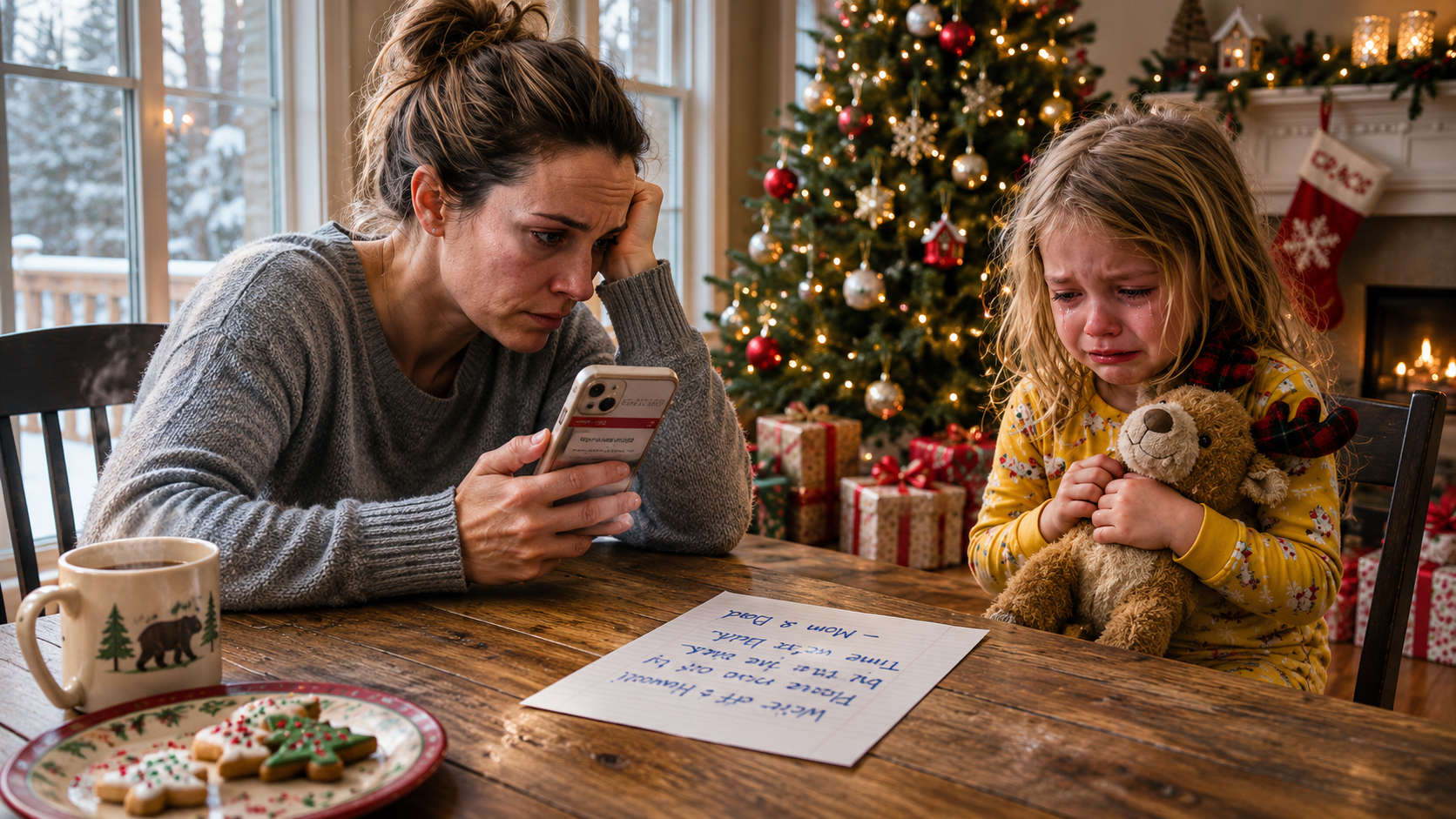
One year earlier, my parents had left us a note saying, “Please move out by the time we’re back.”
One year later, my daughter had given me a note saying, “You never have to leave.”
And of all the things I recovered during that extraordinary year, the most precious wasn’t the inheritance my grandmother had left me.
It was the woman I had finally become.
A woman who no longer begged to be loved.
A mother who no longer apologized for protecting her child.
A daughter who finally understood that her worth had never depended on how much money she could give away.
My family thought Christmas Eve was the day they had thrown us out.
They never realized it was the day they had set us free.
They took away our Christmas vacation, but they accidentally gave us the greatest Christmas gift of all: the courage to build a life where nobody could ever make us feel unwanted again.
THE END.